2026-03-10
Driven by the wave of Industry 4.0 and smart manufacturing, machine vision has become a core technology for applications such as quality inspection, precision measurement, and robotic guidance. However, as camera resolutions leap from megapixels to tens of millions or even hundreds of millions of pixels, and frame rates increase from 30fps to hundreds of fps, data transmission bottlenecks have emerged as a critical pain point constraining the performance of vision systems.
This article delves into the five core challenges facing the machine vision industry and details how the LRES1042PT 10 Gigabit Ethernet card delivers a comprehensive solution through its innovative hardware architecture and giant frame processing technology.
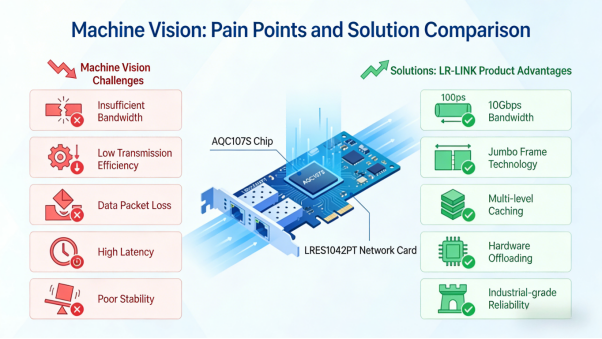
Pain spot 1: Insufficient bandwidth causing image frame drops
Problem Description
The theoretical bandwidth of a traditional Gigabit Ethernet (1GigE) network card is 125MB/s. After accounting for protocol overhead, the actual usable bandwidth is approximately 100MB/s. However, a 12-megapixel 10GigE industrial camera operating at 60fps with 8-bit depth requires 720MB/s of bandwidth. This far exceeds the capacity of Gigabit Ethernet cards, leading to severe image frame loss issues.
Industry Impact
Detection Oversights: Critical defects go undetected due to frame loss, resulting in defective products entering the market.
Production Line Downtime: Frequent visual system alarms force production line stoppages for debugging
• Rising Costs: Reduced inspection speeds to mitigate frame loss cause over 30% drop in production capacity
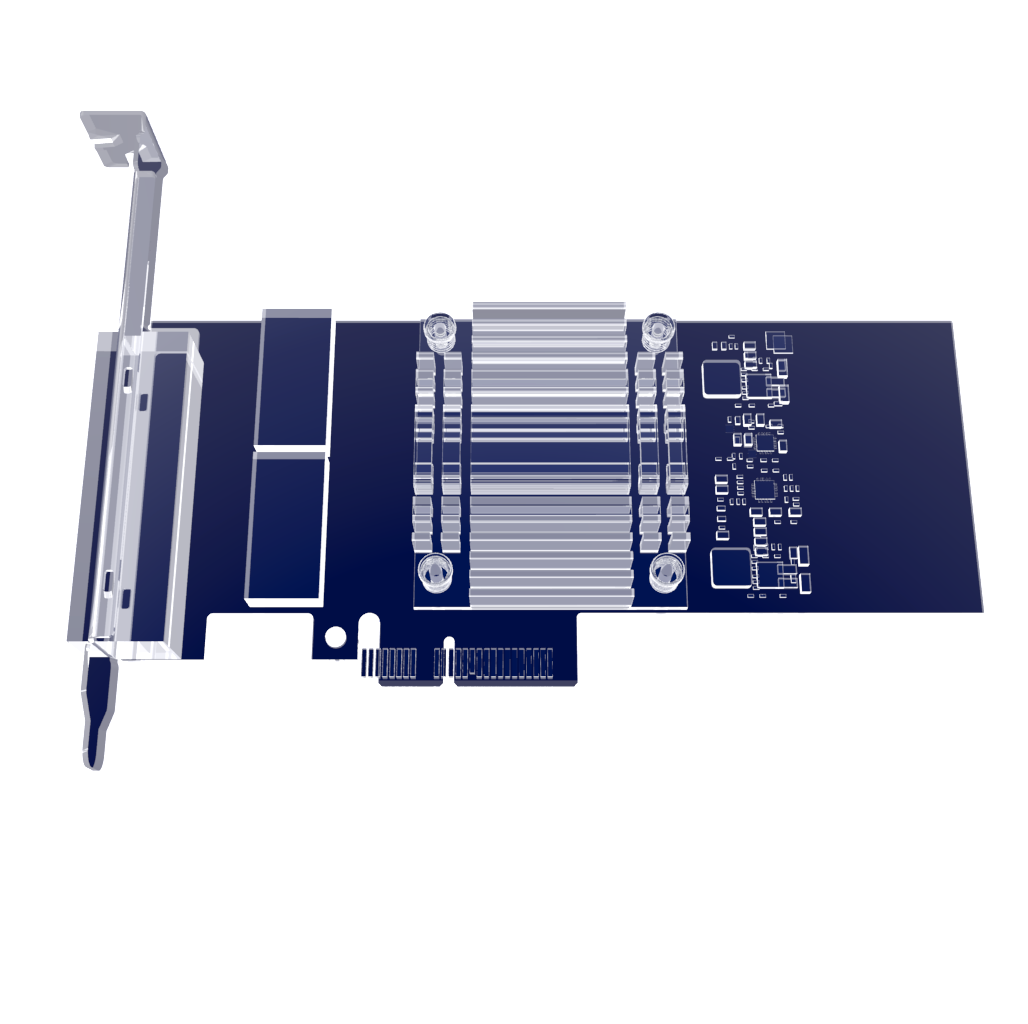
LRES1042PT Solution:The dual-port 10G network card delivers 10Gbps theoretical bandwidth (approximately 1250MB/s actual usable),single port can support simultaneous operation of multiple high-resolution cameras:
Camera Specifications | Frame rate | Bandwidth Requirements | LRES1042PT Support |
12 million pixels | 60fps | 720MB/s | Single-port effortless support |
25 million pixels | 30fps | 750MB/s | Single-port effortless support |
65 million pixels | 20fps | 1300MB/s | Dual-port load balancing |
100 million pixels | 10fps | 1000MB/s | Single-port support |
The MTU of a standard Ethernet frame is 1500 bytes, with approximately 42 bytes (2.8%) allocated to header overhead. When transmitting high-resolution images, the proliferation of small frames triggers CPU interrupt storms, incurs substantial protocol overhead, and accumulates latency.
Efficiency Comparison
Frame Type | Single Frame Payload | Frame Count Requirement | Efficiency |
Standard Frame | 1460 bytes | Approximately 8,219 frames | 97.20% |
Giant Frame | 8960 bytes | Approximately 1339 frames | 99.50% |
LRES1042PT Solution:Jumbo Frame technology extends MTU to 9,000 bytes to achieving:
• Frame reduction: 8,219 frames → 1,339 frames (84% reduction)
• Interrupt reduction: CPU interrupt frequency reduced by 84%
• Overhead reduction: Header ratio drops from 2.8% to 0.47%
• Throughput improvement: Measured data transmission efficiency increased by over 30%
Pain spot 3: Insufficient Buffering Causing Burst Packet Loss
Industrial vision inspection often exhibits burst data flow characteristics: cameras generate large amounts of continuous data instantly upon triggering. If the adapter's receive buffer is insufficient, this leads to buffer overflow, GVSP packet loss, and image corruption.
LRES1042PT Solution:Multi-level buffer architecture ensures reliable reception of burst data flows:

Level 1: On-Chip FIFO Buffer - Inside AQC107S chip, nanosecond response
Level 2: Descriptor Ring Buffer - 4,096 descriptors, millisecond-level buffering
Level 3: System Memory DMA Buffer - Zero-copy direct to application memory
Level 4: Application Layer Image Queue - Supports asynchronous processing
In precision robotic guidance and high-speed sorting applications, end-to-end latency directly affects system accuracy. In traditional solutions, network transmission latency alone can reach several milliseconds. For high-speed moving objects, each millisecond of latency causes 1mm of position deviation.
LRES1042PT Solution:Full-chain low-latency optimization:
Optimization | Technology | Latency Reduction |
Hardware Processing | AQC107S hardware offload | 50% reduction |
Interrupt Mechanism | Interrupt moderation + MSI-X | 30% reduction |
Data Transfer | Zero-copy DMA | 1-2ms reduction |
Time Synchronization | Hardware PTP timestamp | <100ns accuracy |
Pain Point 5: Poor System Stability and Compatibility
Problem Description
Machine vision systems need to operate7×24 hours in harsh industrial environments. Common issues include driver compatibility, thermal problems, electromagnetic interference, and long-term stability concerns.
Hardware Reliability: Marvell AQC107S enterprise-grade controller, MTBF>1 million hours; industrial-grade components, -40°C to 85°C wide temperature operation
Software Compatibility: Full Windows/Linux/VMware support; certified with major vision software (Halcon, VisionPro, LabVIEW)
Long-term Support: LR-LINK 5-year warranty; continuous driver updates
ROI Analysis: Return on Investment
Taking a medium-scale vision inspection production line as an example:
Metric | Traditional | LRES1042PT | Improvement |
Inspection Speed | 30/min | 50/min | 0.67 |
False Positive Rate | 0.02 | 0.001 | -0.95 |
Downtime | 2hrs/week | 0.5hrs/month | -0.94 |
Annual Capacity Loss | ~$70K | ~$4K | -0.94 |
ROI Period: <3 months
Conclusion: Choose LRES1042PT, Choose Reliability
Machine vision system performance depends not only on cameras and algorithms but also on the reliability of underlying data transmission. The LR-LINK LRES1042PT 10GbE adapter, with its 10Gbps high bandwidth, Jumbo Frame technology, multi-level buffering, low-latency design, and industrial-grade reliability, has become the preferred network adapter solution for the machine vision industry.
2026-03-14
2026-03-05