2026-03-28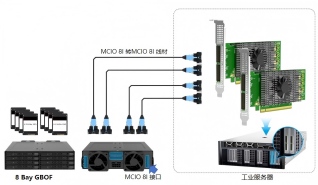
With the rapid iteration of intelligent driving technologies, the collection and storage of road-test data have become a critical bottleneck hindering industry development. This paper provides an in-depth analysis of storage solutions based on PCIe switch hard-drive expansion cards, U.2 expansion cards, and M.2 expansion cards. It focuses on how SSD hot-swapping technology enables seamless disk replacement without interrupting operations, thereby helping providers of end-to-end autonomous driving solutions build efficient data infrastructure.
I. Market Demand for Intelligent Driving Data Storage
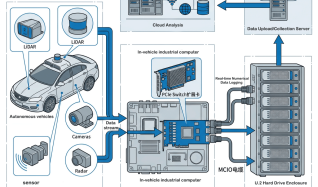
According to forecasts by industry research institutions, the global number of autonomous driving test vehicles will exceed 100,000 by 2025. Autonomous driving solution providers—represented by a certain company—are now deploying large-scale test fleets. Each fleet typically includes more than 15 test vehicles, each equipped with a variety of sensors such as lidar, high-definition cameras, and millimeter-wave radar.
The amount of data generated daily by these sensors is astonishing:
• LiDAR: Hundreds of thousands of point cloud data points per second, with daily volumes reaching 5–10 TB.
• High-definition camera: Multiple 4K/8K video streams, generating 8-15 TB per day.
• Millimeter-wave radar and CAN bus: Continuous data stream, 1–3 TB per day
Traditional SATA SSDs or mechanical hard drives can no longer meet the demands of such high bandwidth and large-capacity writes. The NVMe protocol, paired with the high-speed PCIe interface, has become an inevitable choice, while hard-drive expansion cards are key components for achieving large-capacity, high-reliability storage.
II. Detailed Explanation of PCIe Switch Hard Drive Expansion Card Technology
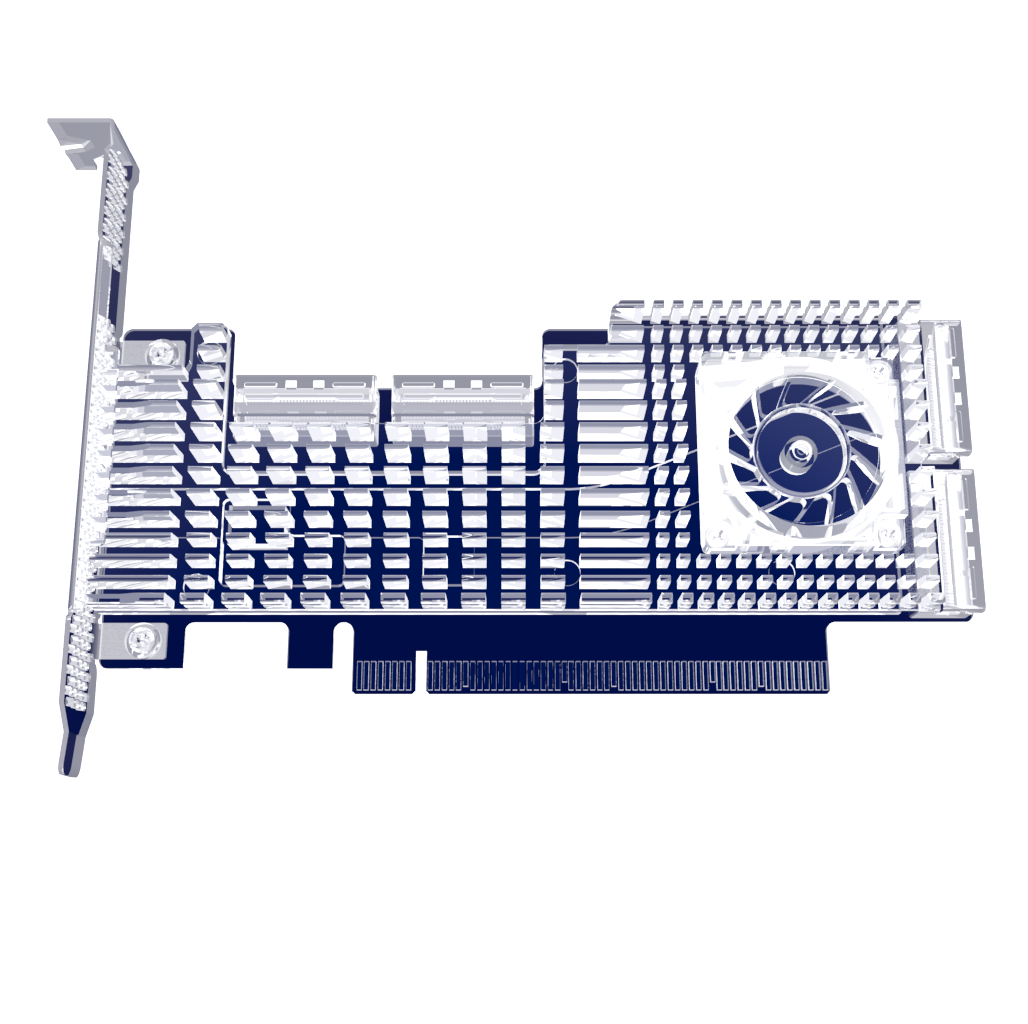
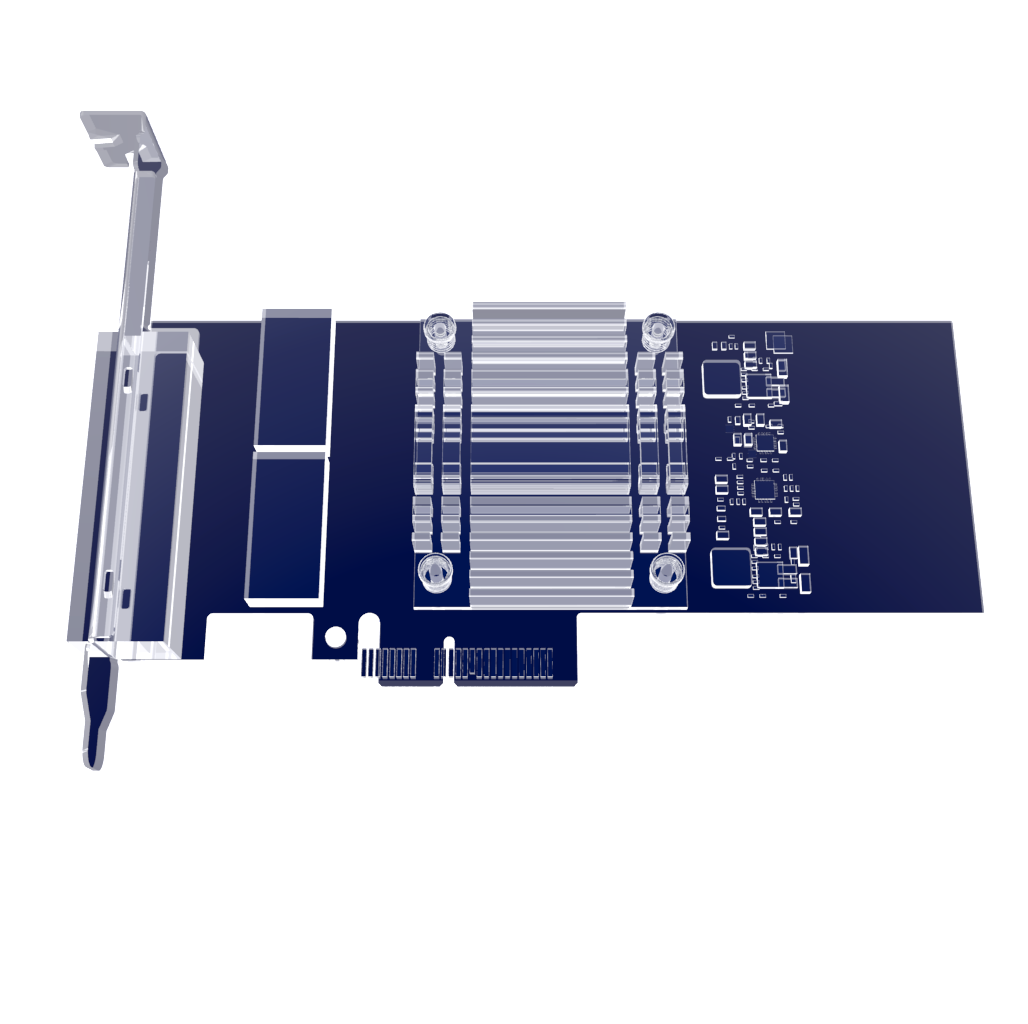
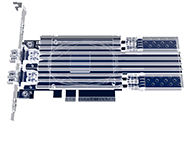
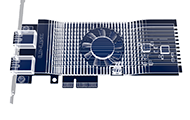
The PCIe switch hard drive expansion card is a core component of in-vehicle storage systems, responsible for extending and distributing the PCIe signals from the industrial PC to multiple SSDs, thereby enabling flexible expansion of storage capacity.
2.1 Operating Principle of the PCIe Switch Chip
A PCIe switch chip is a high-speed signal switching device that can dynamically allocate upstream PCIe ports to multiple downstream devices. In automotive storage applications, PCIe switch expansion cards typically adopt the following architecture:
• Upstream port: Connects to the in-vehicle industrial PC’s CPU via a PCIe x16 slot, receiving high-speed data streams.
• Switching core: A PCIe switch chip that enables intelligent packet routing and bandwidth allocation.
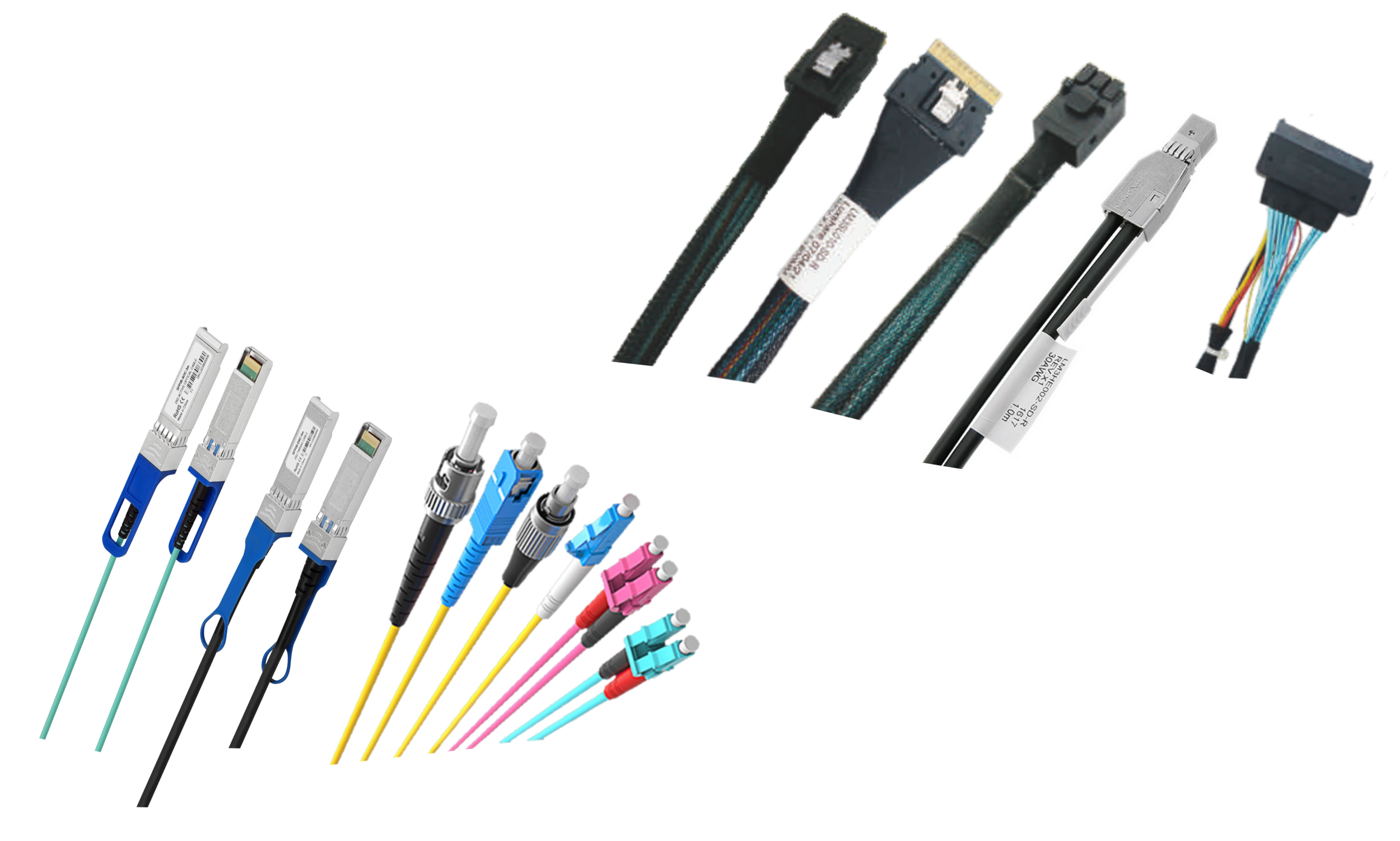
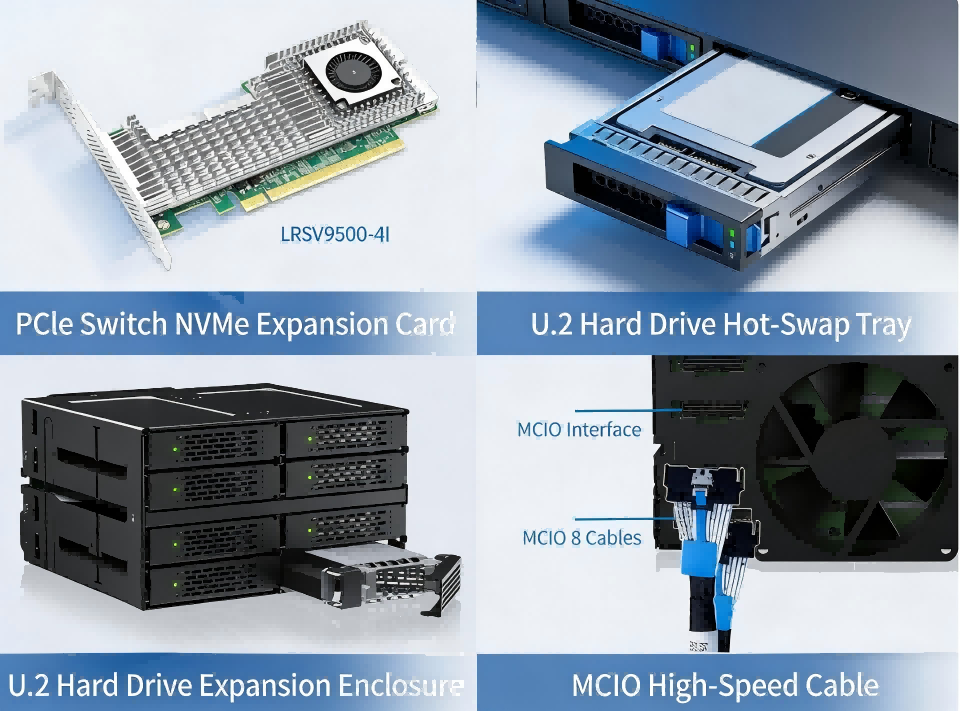
• Downstream port: Outputs multiple PCIe x4 lanes via the MCIO interface, connecting to U.2 or M.2 SSDs.
• U.2 expansion card: Adopts the standard 2.5-inch form factor and supports the SFF-8639 interface. U.2 SSDs offer advantages such as large capacity, excellent heat dissipation, and support for hot-swapping. A single drive can reach a capacity of 16 TB or more, making them ideal for field testing scenarios that require frequent replacement of storage media.
In autonomous driving road testing scenarios, where frequent hard drive replacements are required and high storage capacity is needed, U.2 expansion cards are the better choice.
III. Hard Disk Hot-Swapping and SSD Hot-Swapping Technologies
Hot-swapping of hard drives refers to the technology that allows storage media to be safely inserted or removed while the device is running. In autonomous driving road-testing scenarios, the SSD hot-swapping feature can significantly improve testing efficiency and prevent test interruptions caused by replacing hard drives.
3.1 Principle of Hot-Swapping Technology
Achieving reliable hot-swapping of hard drives requires coordinated efforts across three levels: hardware, firmware, and software.
• Hardware level: The PCIe Switch chip supports dynamic enabling and disabling at the port level; the U.2 hard-drive backplane integrates power sequencing control circuitry to ensure that current surges during insertion and removal are kept under control; the MCIO interface features a fool-proof design to guarantee reliable connections.
• Firmware level: The hard drive enclosure is equipped with a hot-swappable controller that monitors in real time the insertion and removal status of each drive bay and notifies the system via interrupt signals to handle hot-plug events for the devices.
• Software level: The operating system kernel supports hot-plugging of NVMe devices; the file system can safely unmount and remount storage volumes; and applications can listen for device change events and perform corresponding actions.
3.2 Hot-Swapping Procedure
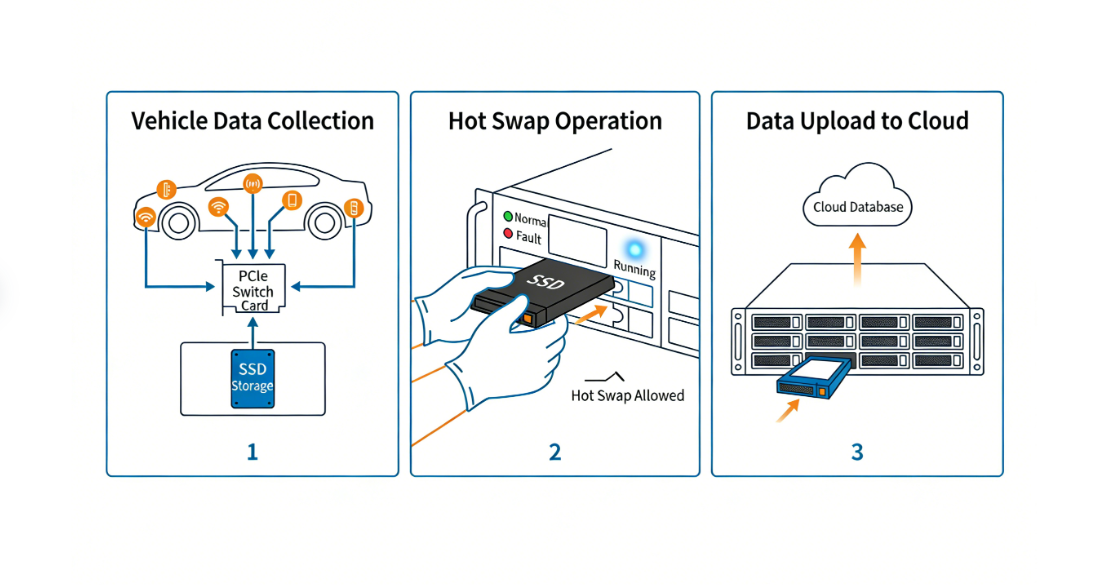
Taking a fleet of 15 road-test vehicles from a certain company as an example, the standard operating procedure for SSD hot-swapping is as follows:
Step 1: Capacity Monitoring. The system backend continuously monitors the remaining capacity of each SSD in real time. When the storage space falls below a preset threshold (e.g., 20%), it automatically sends an alert notification to engineers.
Step 2: Secure Unmounting. The engineer selects the target hard drive through the management interface and performs a secure unmounting operation. The system completes data flushing, cache synchronization, and file system unmounting, ensuring data integrity.
Step 3: Physical Replacement. Leveraging the EZ-Slide extraction tray design of the hard drive enclosure, engineers can perform the replacement while the vehicle is traveling at low speed.
When driving or briefly parking, quickly remove the full disk and insert a new one. The LED status indicator displays the operational status of each disk bay in real time.
Step 4: Automatic Recognition. After the system detects a new disk being inserted, it automatically completes NVMe device initialization, partitioning, and file system mounting. Data writing resumes immediately, and the entire process requires no manual intervention.
IV. A Complete Closed-Loop Solution for Intelligent Driving Data
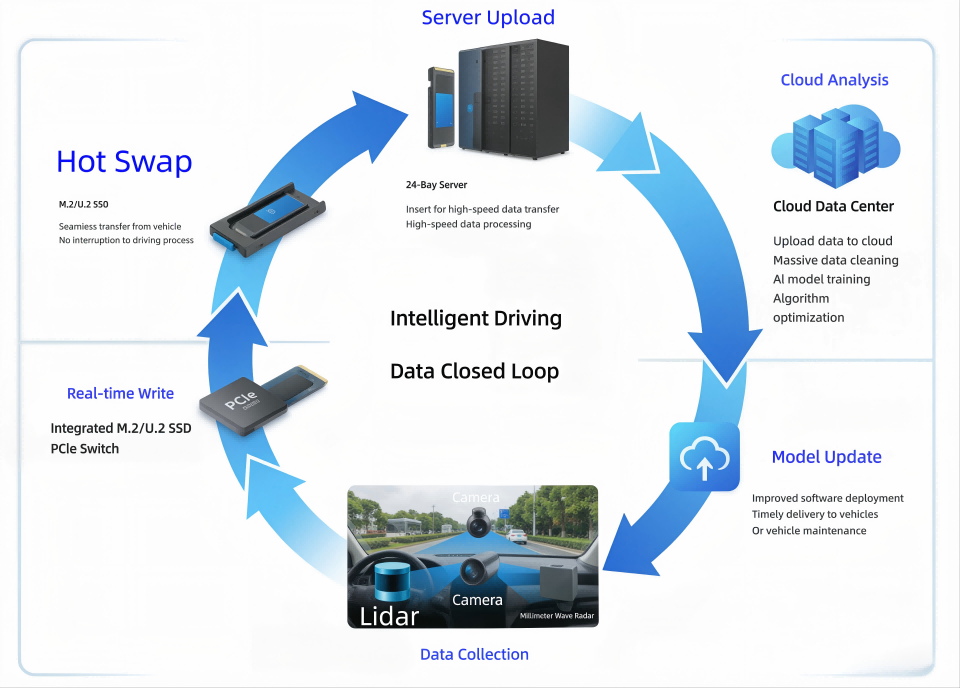
With hot-swappable storage solutions based on PCIe switch hard drive expansion cards and U.2 expansion cards, autonomous driving solution providers can build a complete data closed-loop system.
4.1 Vehicle-side deployment
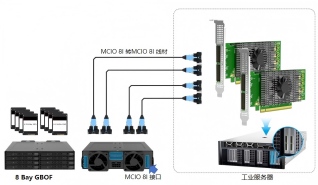
Each road-test vehicle is equipped with one PCIe switch expansion card, which connects to the onboard industrial computer via a PCIe x16 slot. The expansion card is connected via MCIO high-speed cables to an 8-bay U.2 hard-drive enclosure installed in the 5.25-inch optical-drive bay. The enclosure houses eight high-capacity U.2 NVMe SSDs, with each drive available in capacities of 4TB, 8TB, or 16TB. The maximum storage capacity per device can reach up to 128TB.
4.2 Data Collection and Writing
During road tests, the industrial PC collects multi-channel sensor data in real time, including LiDAR point clouds, high-definition video, and radar signals. The data is written to a U.2 SSD via a PCIe 5.0 high-speed channel. Thanks to the aggregate bandwidth of 64 GB, even when multiple 4K video streams are written concurrently, the process remains smooth without any frame drops or latency.
4.3 Hot-swappable disk replacement and data upload
When the hard drive storage is about to reach capacity, engineers quickly replace the SSD using the hot-swappable feature of the hard drive—without stopping the vehicle, allowing testing to continue uninterrupted. The replaced full disk is then inserted into a 24-bay U.2 backplane on a local server and uploaded at high speed via a 10-gigabit network to a cloud data center.
4.4 Cloud-Based Data Analysis
In the cloud, customers’ proprietary algorithm programs run to perform in-depth analysis of collected data: data cleansing removes invalid information, scenario extraction identifies key driving scenarios, automatic annotation generates training samples, and model training optimizes perception and decision-making algorithms. The optimized model is then deployed back into vehicles via OTA, creating a complete data loop.
V. Core Advantages of the Plan
• High Performance: The PCIe switch expansion card delivers an aggregate bandwidth of 64 GB. With PCIe 5.0 performance doubling that of PCIe 4.0, it meets the write requirements of future sensors with even higher resolutions.
• Large capacity: The U.2 expansion card supports enterprise-grade high-capacity SSDs, with a maximum storage capacity of 128 TB per device, meeting the demands of extended road testing.
• Hot-swappable: The SSD hot-swapping design enables disk replacement without stopping the vehicle, boosting road testing efficiency by more than 30% and significantly reducing fleet operating costs.
• High Reliability: All-metal ToughArmor structure, vibration-resistant design, and wide operating temperature range (0°C to 70°C), suitable for harsh in-vehicle environments.
• Easy maintenance: EZ-Slide drawer design, LED status indicators, and hot-swappable hard drive operation that can be performed by a single person.
• Scalable: The modular design supports simultaneous deployment of up to 15 vehicles, and the MCIO interface facilitates system expansion and upgrades.
VI. Industry Outlook
As autonomous driving technology advances toward L3/L4 levels, the volume of road-test data will grow exponentially. The widespread adoption of PCIe 5.0 technology provides ample performance headroom for in-vehicle storage, while the hot-swappable hard-drive design addresses the challenge of continuous data acquisition.
For providers of comprehensive autonomous driving solutions, based on PCIe Switch hard drive expansion cards and U.2 expansion cards,
Storage solutions featuring SSD hot-swappable technology are not only an effective way to address current storage bottlenecks, but also a strategic investment for building long-term data competitiveness.
In the later stages of the intelligent driving competition, the ability to achieve a data closed loop will determine a company's core competitiveness. Choosing a reliable, efficient, and scalable storage infrastructure is a critical decision that every autonomous driving company must prioritize.